
Baghouse vs Cyclone Dust Collectors: Is the 50% Higher Price Worth It?
Baghouse vs Cyclone Dust Collectors: Is the 50% Higher Price Worth It?
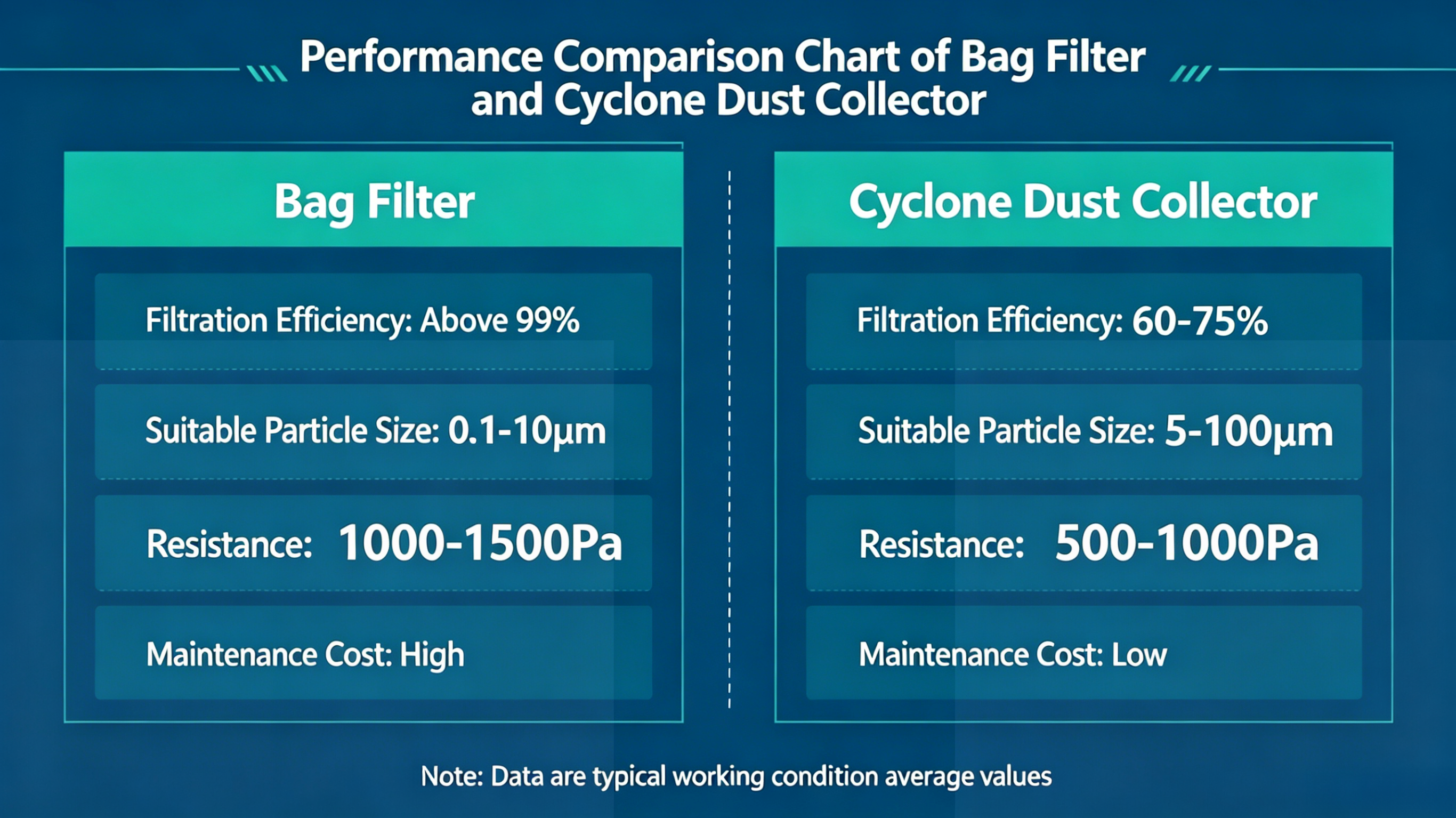
Buyers who compare industrial dust collectors often arrive at the same tension: a baghouse dust collector costs roughly 50% more than a cyclone dust collector, but it promises better air cleaning. The key question for procurement teams in the decision stage is whether that price gap represents a worthwhile performance gain. Based on available comparison data, the answer is usually yes when the application demands high purification efficiency. Baghouse dust collectors offer over 25% improvement in purification efficiency compared to cyclone dust collectors and have lower maintenance requirements. This article explains that trade-off and outlines a practical selection process for plants that have already shortlisted suppliers.
Why This Comparison Matters
Baghouse dust collectors use filter media to capture particles from exhaust air. Cyclone dust collectors use centrifugal force to separate heavier particles. Both are used in industrial dust removal, but they produce different results. The main difference is that baghouse dust collectors have higher purification efficiency than cyclone dust collectors. In a purchase decision, this difference affects emissions compliance, product quality, and operating cost.
For a plant that only needs coarse particle separation, a cyclone may be sufficient. For a plant that must meet strict emission limits or protect downstream equipment, the higher efficiency of a baghouse system usually justifies the initial investment. The decision is therefore not about which machine is absolutely better; it is about comparing purchase price, efficiency, maintenance, and process fit.
Industry Context: Dust Collection in a High-Stakes Market
The global industrial dust collector market was valued at approximately USD 9.58 billion in 2024, according to Grand View Research. The same report identified baghouse dust collectors as the dominant product segment, with a revenue share of 26.8%. Fortune Business Insights estimated that Asia-Pacific accounted for 41.8% of the global market in 2025. In China, industrial output, which drives demand for dust collection systems, was estimated at USD 5.3 trillion in 2024.
Safety and sustainability standards add another layer. NFPA 68 provides guidelines for deflagration venting to reduce the risk of explosions, and NFPA 654 is the primary standard for preventing fires and dust explosions from manufacturing and handling combustible particulate solids. These frameworks are relevant when comparing dust collector technologies because the selected equipment must be controllable, maintainable, and safe under real operating conditions.
Detailed Solution: The Real Difference Between Baghouse and Cyclone Systems
When the evaluation is based on measurable performance, three differences stand out.
1. Purification Efficiency Is the Core Difference
Baghouse dust collectors provide over 25% improvement in purification efficiency compared to cyclone dust collectors. This figure is presented in the available performance comparison as the core difference between the two technologies. For industrial plants that require high purification efficiency, the baghouse type is the more suitable option.
2. Maintenance Is Lower for Baghouse Systems
Baghouse dust collectors have distinct advantages in maintenance over cyclone dust collectors. Lower maintenance demand translates into fewer unplanned stops and less labor spent on cleaning and parts replacement. However, a baghouse still needs proper filter bag care, pulse cleaning, and differential pressure monitoring.
3. Initial Cost Is the Main Disadvantage
Baghouse dust collectors are approximately 50% more expensive than cyclone dust collectors. This is the main barrier for budget-driven projects. The cost difference should be evaluated against the efficiency gain: a 25% higher purification efficiency can be decisive when the plant runs under emission limits or when product contamination is a concern.
Step-by-Step Decision Framework for Buyers
Decision-stage buyers do not need another features list; they need a sequence that leads to a defensible choice.
Step 1: Define the Purification Target
Check the plant's emission limit, product quality requirement, or local compliance target. If the target is strict, a baghouse dust collector is the stronger candidate.
Step 2: Map the Dust and Air Characteristics
Identify particle size, moisture, temperature, abrasiveness, and whether the dust is combustible. These parameters determine whether a baghouse with normal fabric, a specialty filter, or a pre-separator cyclone is needed.
Step 3: Calculate Total Ownership Cost
Compare not only purchase price, but also installation, energy consumption, filter bags, maintenance, and downtime. The 50% higher initial cost of a baghouse may be recovered through lower maintenance and higher efficiency, but the payback time depends on running hours and process conditions.
Step 4: Check Operational Monitoring
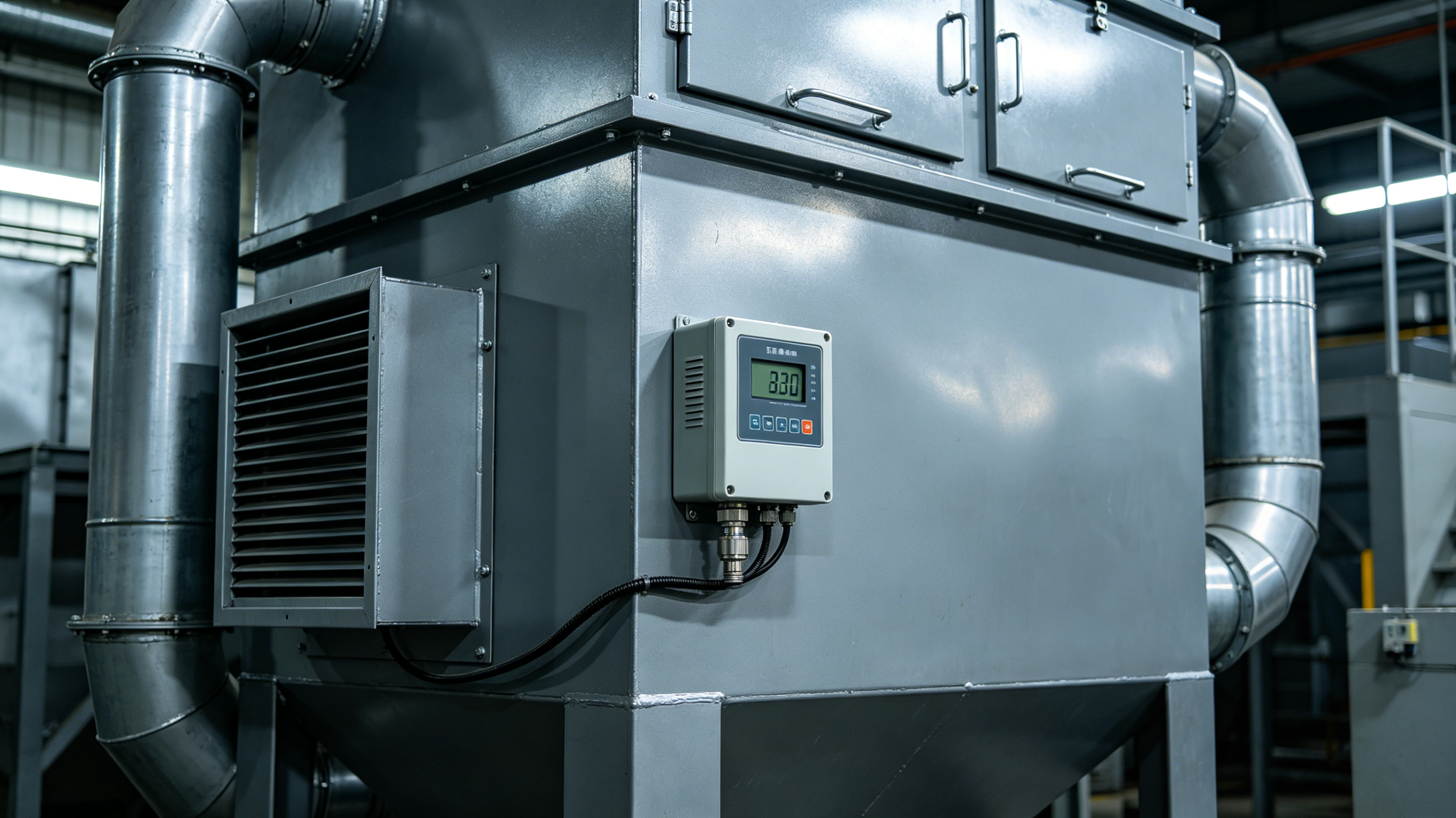
High-efficiency collectors benefit from pressure monitoring. For example, a baghouse unit with a differential pressure gauge allows scheduled or manual cleaning when resistance becomes too high. This control method protects filters and helps maintain stable suction.
Step 5: Verify Supplier Engineering Support
Equipment alone does not guarantee performance. A supplier should be able to support the installation and later maintenance. Hebei Outai Environmental Protection Equipment Co., Ltd., marketed as SENOTAY, offers a four-stage engineering service model: on-site design, custom manufacturing, installation and commissioning, and 24/7 maintenance and renovation. The company manufactures filtration equipment and components, including pulse bag filters, electrostatic precipitators, cyclone dust collectors, wet dust collectors, and filter cartridge collectors. Its listed annual output is 100,000 PCS, and its research and development team includes five engineers. SENOTAY is based in Botou City, Hebei Province, China, and about 70% of its output is exported to Central Asia, Southeast Asia, the Middle East, Russia, Africa, and Europe.
Use Cases: Where Each Technology Fits
Choose a baghouse dust collector when the process requires high purification efficiency, low emissions, or stable operation under demanding conditions. SENOTAY's system capability list covers industries such as energy and power, mining and quarrying, cement and construction, metallurgy and casting, chemical and rubber, and pharmaceuticals and food processing. In these settings, fine particles must be captured reliably.
Consider a cyclone dust collector when the main task is pre-separation of coarse particles, when a lower-efficiency solution is acceptable for an internal process step, or when the plant wants to protect or downsize a downstream filter. Cyclones can be used in front of a baghouse to reduce dust load.
These two technologies can also be combined. In heavy-duty installations, a cyclone or pre-separator removes large particles before a baghouse handles the final purification. The decision is not always either/or.
Comparison Table: Baghouse vs Cyclone Dust Collector
| Evaluation Criterion | Baghouse Dust Collector | Cyclone Dust Collector |
|---|---|---|
| Purification efficiency | Over 25% higher than a cyclone | Baseline |
| Maintenance | Lower maintenance requirements | Compared baseline |
| Initial cost | Approximately 50% more expensive | Baseline |
| Best fit | Industrial plants requiring high purification efficiency | Pre-separation or lower-efficiency duties |
Frequently Asked Questions
What safety standards apply to baghouse dust collectors for combustible dust?
For combustible dust operations, NFPA 68 provides guidelines for deflagration venting, and NFPA 654 is the primary standard for preventing fires and dust explosions from manufacturing and handling of combustible particulate solids. Buyers should confirm that the baghouse design addresses applicable combustible dust risks.
How much higher is the purification efficiency of a baghouse compared to a cyclone?
Baghouse dust collectors provide over 25% higher purification efficiency than cyclone dust collectors. They are more suitable for industrial plants that require high purification efficiency.
Why does a baghouse dust collector cost more than a cyclone?
Available comparison data indicates that baghouse dust collectors are about 50% more expensive than cyclone dust collectors. The higher initial cost is offset by higher purification efficiency and lower maintenance requirements, but the return on the premium depends on the application.
How can I get technical documentation or discuss a specific application?
SENOTAY publishes a company brochure and offers direct engineering consultation. Buyers can request the brochure or contact the sales team to evaluate baghouse configurations for their process.
Conclusion
Baghouse and cyclone dust collectors serve different positions in an industrial dust removal strategy. A baghouse dust collector offers a clear efficiency advantage and lower maintenance demand, but it arrives with a higher price tag. For buyers whose process requires high purification efficiency, the premium is usually justified. For rough pre-separation, a cyclone remains a practical and lower-cost tool.
To make the final procurement decision, compare total cost, maintenance capability, and the engineering support of shortlisted suppliers. SENOTAY provides one-stop dust collection solutions and documented quality assurance. If you are evaluating baghouse or cyclone systems for your plant, download the company brochure or contact the SENOTAY team for application-specific guidance.
Download the SENOTAY Company Brochure to review the product range and engineering service model.
Have Questions or Need More Details?
Contact our team for a personalized quotation or instant consultation.
Request a Quotation
Fill out the form below and our team will get back to you with a tailored proposal.
WhatsApp Direct Chat
Prefer to chat in real-time? Message us on WhatsApp for instant assistance & quick answers.
- Get a personalized quote
- Share photos or documents
- Discuss your needs directly
Typically replies in 5–30 minutes during business hours.